Monday, February 15, 2016

Relief Society Lesson, Sunday, February 14, 2016

Today's lesson was Lesson #3: Adversity--Part of God's Plan for Our Eternal Progress from the President Howard W. Hunter manual. The lessons was taught by Lindsie Mendenhall.

Lindsie had the class split into 5 different groups. Each group was assigned a section from the lesson and asked to read it then discuss the answers to questions that Lindsie gave each group. Below are the questions the different groups were asked to consider. Take a moment to read each section (click on the lesson title above to be redirected to lesson) and reflect on what your answers to these questions would be. If you would like to share some of your thoughts and feelings, please do not hesitate to comment below. We would love to hear from you!

Theme: “When [the difficulties of mortality] humble us and refine us and teach us and bless us, they can be powerful instruments in the hands of God to make us better people.”
  • How can it help us to know that adversity is part of God's plan for our eternal progress? Why do you think adversity is a necessary part of mortality?

  • Review President Hunter's teachings in section 2 about some of the purposes of adversity. How have you seen that adversity can we come to see adversity from Lord's eternal perspective?

  • Why, as President Hunter teaches, do we have reason to be happy and optimistic even in times of difficulty? How can we develop greater optimism during such times? What are some blessings we continue to have even during the most severe adversity?

  • How do we accept the Savior's invitation to let him carry our burdens and lighten our loads? What does it mean to take His yoke upon us? How has the Savior helped you in times of difficulty?

  • President Hunter teaches that feelings of fear about the tribulations of the last days do not come from God. How is living by fear harmful? How can we live with hope and faith rather than by fear? 
Conclusion- 

"Are we prepared to surrender to God's commandment? 

Are we prepared to achieve victory over our appetites? 

Are we prepared to obey righteous law?

If we can honestly answer yes to those questions, we can bid fear to depart from our lives. Surely the degree of fear in our hearts may well be measured by our preparation to live righteously- living in a way that should characterize every Latter-day- Saint in every age and time." (President Howard W. Hunter)

Sunday, January 31, 2016

Relief Society Lesson, January 31, 2016


This week's lesson was from the Howard W. Hunter lesson manual, Chapter 2: "My Peace I Give Unto You." The lesson was taught by Katia Brebberman.

(All QUOTES are taken directly from the manual and were read out loud in class today.)

How can we find true inner peace?

  • By turning to God
  • By trusting Him
  • By exercising faith
  • By striving to do His will

What are some synonyms for the word peace that can help us better understand the definition of this word?  tranquility, calm, quiet, order, harmony, no violence

How can we gain this inner peace promised to us by Christ?

QUOTE: On the last occasion that Jesus had supper with the Twelve, he washed their feet, broke bread for them, and passed them the cup; then, after Judas had left their midst, the Master spoke to them at some length. Among other things, he told of his impending death and of the legacy he left for each of them. He had accumulated no goods, property, nor wealth. The record tells us of no possessions other than the clothing he wore, and on the next day after the crucifixion this would be divided by the soldiers, who would cast lots for his coat. His bequest was given to his disciples in these simple yet profound words: “Peace I leave with you, my peace I give unto you: not as the world giveth, give I unto you. Let not your heart be troubled, neither let it be afraid.” (John 14:27)

What did legacy/inheritance did Christ leave His disciples?

QUOTE: Within a few hours they would be subjected to trouble, but with his peace they could overcome fear and stand firm.

His last statement to them before the closing prayer on that memorable evening was this: “… in the world ye shall have tribulation: but be of good cheer; I have overcome the world.” (John 16:33.)
Read Mosiah 16:9 and John 14:6. How do these verses describe Christ's role in our lives and in the world?
QUOTE: When we try to help those who have offended us, when we pray for those who have unrighteously used us, our lives can be beautiful. We can have peace when we come into a unity with the Spirit and with each other as we serve the Lord and keep his commandments.7
The world in which we live, whether close to home or far away, needs the gospel of Jesus Christ. It provides the only way the world will ever know peace. … We need a more peaceful world, growing out of more peaceful families and neighborhoods and communities. To secure and cultivate such peace, “we must love others, even our enemies as well as our friends” [Teachings of Presidents of the Church: Joseph Smith(2007), 393]. … We need to extend the hand of friendship. We need to be kinder, more gentle, more forgiving, and slower to anger.
We need to be the start of the chain reaction for good in this world. Where does President Hunter recommend we start? In our own FAMILIES!
QUOTE: There is no promise of peace to those who reject God, to those who will not keep his commandments, or to those who violate his laws. The Prophet Isaiah spoke of the decadence and corruption of leaders and then continued in his admonitions by saying: “But the wicked are like the troubled sea, when it cannot rest, whose waters cast up mire and dirt. There is no peace, saith my God, to the wicked.” (Isa. 57:20–21.) …
… Indifference to the Savior or failure to keep the commandments of God brings about insecurity, inner turmoil, and contention. These are the opposite of peace. Peace can come to an individual only by an unconditional surrender—surrender to him who is the Prince of peace, who has the power to confer peace.
A key to finding and maintaining the inner peace of Christ is by keeping His commandments and living righteously. We must be worthy of His Spirit and companionship. He has also promised that if we are living worthy, we can ask and He will bless us with the things we stand in need of.
woman anointing Christ’s feet
QUOTE: A life filled with unselfish service will also be filled with peace that surpasses understanding. … This peace can come only through living the principles of the gospel. These principles constitute the program of the Prince of Peace.
It is interesting to note what a role service/serving others plays in every aspect of the gospel.
QUOTE: We pray that Satan’s efforts will be thwarted, that personal lives can be peaceful and calm, that families can be close and concerned with every member, that wards and stakes, branches and districts can form the great body of Christ, meeting every need, soothing every hurt, healing every wound until the whole world, as Nephi pleaded, will “press forward with a steadfastness in Christ, having a perfect brightness of hope, and a love of God and of all men. …
“My beloved brethren,” continued Nephi, “this is the way; and there is none other way.” (2 Nephi 31:20–21.)
QUOTE: Jesus was not spared grief and pain and anguish and buffeting. No tongue can speak the unutterable burden he carried, nor have we the wisdom to understand the prophet Isaiah’s description of him as “a man of sorrows.” (Isa. 53:3.) His ship was tossed most of his life, and, at least to mortal eyes, it crashed fatally on the rocky coast of Calvary. We are asked not to look on life with mortal eyes; with spiritual vision we know something quite different was happening upon the cross.
Peace was on the lips and in the heart of the Savior no matter how fiercely the tempest was raging. May it so be with us—in our own hearts, in our own homes, in our nations of the world, and even in the buffetings faced from time to time by the Church. We should not expect to get through life individually or collectively without some opposition.
The Savior experienced every tribulation and affliction and yet demonstrated patience and peace. Cultivate faith. There will be opposition--but the Savior demonstrated how to find and live with peace.
QUOTE: One may live in beautiful and peaceful surroundings but, because of inner dissension and discord, be in a state of constant turmoil. On the other hand, one may be in the midst of utter destruction and the bloodshed of war and yet have the serenity of unspeakable peace. If we look to man and the ways of the world, we will find turmoil and confusion. If we will but turn to God, we will find peace for the restless soul. This was made clear by the words of the Savior: “In the world ye shall have tribulation” (John 16:33); and in his bequest to the Twelve and to all mankind, he said, “Peace I leave with you, my peace I give unto you: not as the world giveth. …” (John 14:27.)
The following story about Christ was read from the manual:
Let me recall one of the great stories of Christ’s triumph over that which seems to test us and try us and bring fear to our hearts. As Christ’s disciples had set out on one of their frequent journeys across the Sea of Galilee, the night was dark and the elements were strong and contrary. The waves were boisterous and the wind was bold, and these mortal, frail men were frightened. Unfortunately there was no one with them to calm and save them, for Jesus had been left alone upon the shore.
As always, he was watching over them. He loved them and cared for them. In their moment of greatest extremity they looked and saw in the darkness an image in a fluttering robe, walking toward them on the ridges of the sea. They cried out in terror at the sight, thinking that it was a phantom that walked upon the waves. And through the storm and darkness to them—as so often to us, when, amid the darknesses of life, the ocean seems so great and our little boats so small—there came the ultimate and reassuring voice of peace with this simple declaration, “It is I; be not afraid.” Peter exclaimed, “Lord, if it be thou, bid me come unto thee on the water.” And Christ’s answer to him was the same as to all of us: “Come.”
Peter sprang over the vessel’s side and into the troubled waves, and while his eyes were fixed upon the Lord, the wind might toss his hair and the spray might drench his robes, but all was well. Only when with wavering faith he removed his glance from the Master to look at the furious waves and the black gulf beneath him, only then did he begin to sink. Again, like most of us, he cried, “Lord, save me.” Nor did Jesus fail him. He stretched out his hand and grasped the drowning disciple with the gentle rebuke, “O thou of little faith, [why] didst thou doubt?” Then safely aboard their little craft, they saw the wind fall and the crash of the waves become a ripple. Soon they were at their haven, their safe port, where all would one day hope to be. The crew as well as his disciples were filled with deep amazement. Some of them addressed him by a title which I declare today: “Truly thou art the Son of God.” (Adapted from Farrar,The Life of Christ, pp. 310–13; see Matt. 14:22–33.)
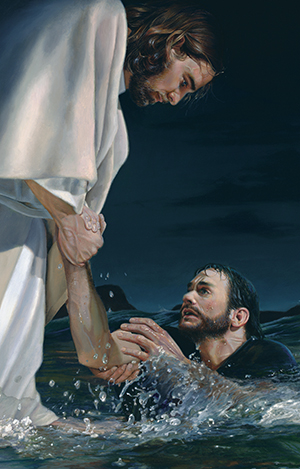
Christ with Peter in water
Never cease to call upon the Lord He will reach out HIs hand and help us. Each of us will have trials, afflictions, and hardships--it is a key reason why we are here on earth. But we have the Savior who will always reach out His hand to us and promises His peace. Our Heavenly Father has a plan for each of us...we need not fear. Our eyes must be firmly fixed on the Savior at all times.
QUOTE: It is my firm belief that if as individual people, as families, communities, and nations, we could, like Peter, fix our eyes on Jesus, we too might walk triumphantly over “the swelling waves of disbelief” and remain “unterrified amid the rising winds of doubt.” But if we turn away our eyes from him in whom we must believe, as it is so easy to do and the world is so much tempted to do, if we look to the power and fury of those terrible and destructive elements around us rather than to him who can help and save us, then we shall inevitably sink in a sea of conflict and sorrow and despair.
At such times when we feel the floods are threatening to drown us and the deep is going to swallow up the tossed vessel of our faith, I pray we may always hear amid the storm and the darkness that sweet utterance of the Savior of the world: “Be of good cheer; it is I; be not afraid.” (Matt. 14:27.)


Sunday, January 24, 2016

Relief Society Lesson, January 24, 2016

Shipshape and Bristol Fashion: Be Temple Worthy--in Good Times and Bad Times

by Elder Quentin L. Cook
Of the Quorum of the Twelve Apostles

Today's lesson was taught by Amy Groves.
(The quotes listed below are directly from Elder Cook's talk which can be accessed by clicking the link above. "Comments made" were those thoughts offered by different sisters in class.)

What does it mean to be "shipshape and bristol fashion"?

Quote: When I was a young missionary assigned to the British Mission, my first area of labor was in what was then the Bristol District. One of the local Church leaders emphasized that missionaries serving in that area needed to be “shipshape and Bristol fashion.” 
Initially I didn’t understand the point he was making. I soon learned the history and meaning of the nautical phrase “shipshape and Bristol fashion.” At one time Bristol was the second busiest port in the United Kingdom. It had a very high tidal range of 43 feet (13 m), the second highest in the world. At low tide when the water receded, the old ships would hit bottom and fall on their sides, and if the ships were not well built, they would be damaged. In addition, everything that was not carefully stowed away or tied down would be thrown in a chaotic fashion and ruined or spoiled.  After I understood what that phrase meant, it was clear that this leader was telling us that, as missionaries, we must be righteous, follow rules, and be prepared for difficult situations.
This same challenge is applicable to each of us. I would describe being “shipshape and Bristol fashion” as being temple worthy—in good times and in bad times.

We know one of the purposes of coming to earth is to be tried and tested although we never know when those trials may come or what we may be asked to face. Despite the uncertainties, we do know that righteous living and preparation can provide divine protection in any circumstance. "If we are prepared, we shall not fear".

What is the difference between being perfected through Christ's Atonement and perfectionism?

Comments Made:

  • One brings  hope and joy and the other brings despair and never measuring up.
  • Perfectionism often means wanting to control everything and always be in control versus allowing the Savior to be in control and trusting His wisdom and timing.
What do we know about Satan's plan?
Quote: The adversary has been successful in planting a great myth in the minds of many people. He and his emissaries declare that the real choice we have is between happiness and pleasure now in this life and happiness in a life to come (which the adversary asserts may not exist). This myth is a false choice, but it is very seductive.

Compare that to the Savior's beautiful plan for us.
Quote: The ultimate noble purpose of God’s plan of happiness is for righteous disciples and covenant families to be united in love, harmony, and peace in this life and attain celestial glory in the eternities with God the Father, our Creator; and His Beloved Son, Jesus Christ, our Savior.

Take a few minutes to read the Sermon on the Mount found in Matthew 5 or 3 Nephi 12. What stands out to you about the importance of having a solid foundation and being built "within"?

Comments Made:
  • These are ACTION words. We are asked to be constantly seeking, growing, learning vs. the world who would have us believe it is "all about me". We cannot be complacent with the world or worldly things. We need to take action and prepare ourselves.
  • It is interesting to note that during this time period when Christ gave the Sermon on the Mount, the Jews performed very outward/physical religious observance but Christ is actually speaking about what is internal. We cannot judge what we see with our physical eyes. We must learn to see with our hearts. Look inward.
  • We are in the process of "becoming". It is a lifetime process, not a one time event. As long as we are on the right course, we are progressing and can be assured we are trying and doing our best.
  • Lots of the attributes described in these verses are those that we often develop as we are experiencing trials. With a change in attitude, we truly can come to see the blessings and opportunities that are presented to us in the form of trials and adversity. We must learn to see what the Lord is trying to teach us and help us become.
  • We become the light spoken of by Christ as we strive to do those things every day that invite that light into our lives.
  • The world tries to teach us it is all about "me". Christ is teaching us to focus outside ourselves and the joy found in serving others.
Quote: For many centuries the gospel of Jesus Christ has inspired beliefs and established standards of conduct as to what is righteous, desirable, and moral and results in happiness, felicity, and joy. However, the principles and basic morality the Savior taught are under serious attack in today’s world. Christianity is under attack. Many believe that what is moral has basically changed.

We live in difficult times. There is an increased tendency to “call evil good, and good evil.” A world that emphasizes self-aggrandizement and secularism is cause for great concern. One prominent writer, not of our faith, has put it this way: “Unfortunately I see little evidence that people are actually happier in the emerging dispensation, or that their children are better off, or that the cause of social justice is well-served, or that declining marriage rates and thinning family trees … promise anything save greater loneliness for the majority, and stagnation overall.”
Elder Cook discusses 3 things we can do to improve our preparation and ability to live righteously.
1) Righteous Self-Control and Conduct
Quote: ...“self-control is like a muscle: the more you use it, the stronger it gets. Avoiding something tempting once will help you develop the ability to resist other temptations in the future.”
A principle of eternal progression is that exercising self-control and living righteously strengthen our ability to resist temptation. This is true both in the spiritual realm and in temporal matters.

2) Honoring the Sabbath will increase righteousness and be a protection for the family.
Quote: In the last six months, a most remarkable change has occurred in the Church. This has been in the response of the members to renewed emphasis on the Sabbath by the First Presidency and Quorum of the Twelve and to President Russell M. Nelson’s challenge to make the Sabbath a delight.27 Many members understand that truly keeping the Sabbath day holy is a refuge from the storms of this life. It is also a sign of our devotion to our Father in Heaven and an increased understanding of the sacredness of sacrament meeting. Still, we have a long way to go, but we have a wonderful beginning. I challenge all of us to continue to embrace this counsel and improve our Sabbath worship.

3) Divine protections are provided when we are righteous.
Quote: My dear brothers and sisters, life is not easy, nor was it meant to be. It is a time of testing and trial. Like the old ships in Bristol Harbor, there will be times when the tide goes out and it seems as if everything in this world keeping us afloat disappears. We may hit the bottom and even be tipped over on our sides. Amid such trials, I promise you that living and maintaining temple-worthy lives will hold together all that really matters. The sweet blessings of peace, happiness, and joy, along with the blessings of eternal life and celestial glory with our Heavenly Father and His Son, Jesus Christ, will be realized.


Sunday, December 20, 2015

Sunday, December 20, 2015

Today Andrea Tholstrom taught the Relief Society lesson from the Ezra Taft Benson manual, Chapter 24 "A Christ-Centered Life".

Andrea began by sharing a story about an event that happened a couple of weeks ago in their home. She had set out their family nativity on a table that she frequently walked by during the day. As she was passing by the nativity one day, she noticed someone had moved the animals so that they were circled around the baby Christ figure. When she asked her children about it, Sophie admitted she had moved the animals so that they could better see the Christ child. A couple of days later, Andrea noticed all the characters in the nativity were now facing in and circled around the Christ child. Again, Sophie admitted she had moved them because she wanted to be sure EVERYONE could see the baby. Andrea was touched by the actions of her daughter who wanted Christ to be the center of the nativity and wanted to be sure everyone could see Him.

Is our life centered around Christ?

The following was shared from the lesson manual, Chapter 24:

President Ezra Taft Benson frequently quoted the Savior’s counsel to the twelve Nephite disciples: “What manner of men ought ye to be? Verily I say unto you, even as I am” (3 Nephi 27:27).

“I testify to you that there is no greater, more thrilling, and more soul-ennobling challenge than to try to learn of Christ and walk in His steps. Our model, Jesus Christ, walked this earth as ‘the Exemplar.’ He is our Advocate with the Father. He worked out the great atoning sacrifice so we could have a fullness of joy and be exalted in accordance with His grace and our repentance and righteousness. He did all things perfectly and commands that we be perfect even as He and His Father are perfect. (See 3 Ne. 12:48.)
“‘What would Jesus do?’ or ‘What would He have me do?’ are the paramount personal questions of this life. Walking in His way is the greatest achievement of life. That man or woman is most truly successful whose life most closely parallels that of the Master.”
As a class, we read 2 Peter 1:4-8. This scripture by the Apostle Peter spoke of the process by which a person can be made a partaker “of the divine nature”. This is important, for if we truly become partakers of the divine nature, we shall become like Him.
Andrea focused on 3 divine attributes of Christ: faith, patience, and kindness.
 Jesus wearing white and red robes, with arms outstretched, standing near His Apostles on a ship that is being tossed on large waves.
1) FAITH: Consider the beautiful account of Christ calming the storm. 
What are some of the storms we face in life? (Mental health issues, family members who are inactive or struggling with their faith, financial concerns, children fighting, the world attacking sacred beliefs, etc.) 
How can faith in Christ help us "calm our storms" and find peace? We must have faith in Jesus Christ. We must CHOOSE to have faith. It is a choice we make daily about where to place our trust and where to center our beliefs. It doesn't mean our storms or trials will instantly be removed but it does mean we can have firm hope that we will be successful and find ultimate peace THROUGH our trials. 
2) PATIENCE: Andrea shared the story about a favorite aunt of hers that has suffered some serious trials and challenges in her life but has consistently chosen to exercise patience and faith in the Lord Jesus Christ. 
From the lesson manual: "Patience is another form of self-control. It is the ability to postpone gratification and to bridle one’s passions. In his relationships with loved ones, a patient man does not engage in impetuous behavior that he will later regret. Patience is composure under stress. A patient man is understanding of others’ faults.
A patient man also waits on the Lord. We sometimes read or hear of people who seek a blessing from the Lord, then grow impatient when it does not come swiftly. Part of the divine nature is to trust in the Lord enough to “be still and know that [he is] God” (D&C 101:16).
A [person] who is patient will be tolerant of the mistakes and failings of his loved ones. Because he loves them, he will not find fault nor criticize nor blame."
3) KINDNESS: Andrea shared the following images and story from the New Testament.
John 8:2–11, A group of men tries to stone the woman taken in adultery
The Pharisees and scribes felt very justified in their treatment of this woman who was taken in adultery. Look at their faces. When she was brought before Christ, they expected the full extent of the Law of Moses to be exercised. She deserved it. She had sinned. But look at the Savior's face.
He chose to look upon her with kindness and compassion. How can His example influence how we look upon and treat others? Do we hope Christ will look upon us with forgiveness, kindness and compassion? Should we not do the same to others? 
"One who is kind is sympathetic and gentle with others. He is considerate of others’ feelings and courteous in his behavior. He has a helpful nature. Kindness pardons others’ weaknesses and faults. Kindness is extended to all—to the aged and the young, to animals, to those low of station as well as the high."
As we approach this Christmas season, may we each stop and contemplate how we can turn our lives more to the Savior. May we reach out to others and seek to alleviate their burdens through patience and kindness. 

Sunday, November 29, 2015

5th Sunday Combined Meeting, November 2015

We met today as a combined group for a 5th Sunday lesson taught by Bishop Kevin Franson. Below you will find Bishop Franson's notes and quotes as well as additional comments and observations that were made by class members.

"Doubt your doubts before you doubt your faith."  
(President Dieter Uchtdorf)

Consider the following quotes. How accurately do they describe the time we currently live in? Take particular note of the individual who is speaking and when the quote was given. (Clicking on the reference at the end of the quote will take you to the full article.)

Today there are many issues under debate as controversies rage all around us. It should be evident to all that we need divine direction, as men and women who argue their causes seem to be unable to come to workable or peaceable solutions. It is sad indeed that the world does not know or accept the fact that in our midst is a prophet through whom God can direct the solution of world problems.

I stress that I come neither as an alarmist nor as a pessimist, but as one who seeks in his gentle way to remind us of this reality lest we be struck “with wonder and astonishment” and become dismayed and dislocated by difficulties that emerge when “all hell is moved,” because the restored kingdom is really rolling now. We may never become accustomed to untrue and unjust criticism of us but we ought not to be immobilized by it. Neither should we be surprised at the proximity of such protagonists and the falsity and the fury of their pronouncements. President Joseph F. Smith said, “there are those—and they abound largely in our midst—who will shut their eyes to every virtue and to every good thing connected with this latter-day work, and will proud out floods of falsehood and misrepresentation against the people of God.” President Smith, who endured so much of that proximate persecution, did what we must also do. He said of such detract , “I forgive them for this. I leave them in the hands of the just Judge” (Gospel Doctrine, p. 337).
President Cannon, who knew that the adversary regards this telestial turf as his own, said that Satan will vigorously resist all rezoning efforts because this is his world. President Cannon further observed that the Saints—meaning you and I—must not make the mistake of assuming the existence of any truce between the forces of Satan and God. To believe so, said President Cannon, is “a very great delusion, and a very common one.”
President Cannon then warned that the forms of resistance to righteousness will strike us “with wonder and astonishment.” This, he said, would occur because “the war” which was waged in heaven has been transferred to the earth,” and that this conflict, he said, “will [come to] occupy the thoughts and minds of all the inhabitants of the earth” (Journal of Discourses 11:227–29). Brothers and sisters, The Church of Jesus Christ of Latter-day Saints will be at the epicenter of all that.
President Cannon, May 1866 [from Elder Maxwell's talk]

What do these quotes teach us about the Gospel?
They help to validate, sustain, and verify that these are prophets, seers, and revelators.

What do you learn from them?

What about today's events, issues, challenges?
We have prophets, seers, revelators
What are they currently saying?
Do we believe that they are prophets, seers, and revelators?

What if we still have questions? Where do we find answers?
  • Desire to believe
  • Scriptures/prophets :: what scriptures tell us to ask?

Mormon 9:21
James 1:5
  • Do the will of God
  • Prayer
  • Ponder
  • Fasting
  • Trusted Friends
  • Be obedient

  • Counsel with those with priesthood keys (bishop, stake president, quorum president)
  • Delegated authority with keys (auxiliary presidents)


Not…
The Internet
Social media
Must be careful in social media, doubts/questions are natural and normal, where and how we express them can impact others … greatly

Mormon 9:27
O then despise not, and wonder not, but hearken unto the words of the Lord, and ask the Father in the name of Jesus for what things soever ye shall stand in need. Doubt not, but be believing, and begin as in times of old, and come unto the Lord with all your heart, and work out your own salvation with fear and trembling before him.

(Another excellent resource regarding this topic is Elder Ballard's talk "God Is At the Helm" from the October 2015 General Conference. Click HERE for the link.)

Thursday, October 8, 2015

Regional Conference: September 2015

An amazing summary of the Regional Conference that was held in September. Thank you to whoever took these notes and shared it on google docs.

Regional Conference (please click here for the link)

Lesson Schedule for Remainder of 2015

Over the last 2 months, we have had some adjustments made to our Relief Society lesson schedule for the remainder of this year. Here is the current "revised" schedule:

10/4 General Conference 

10/11 Ezra Taft Benson Manual Chapter 19: Leadership (Teacher: Lyndsie Mendenhall)

10/18 Ezra Taft Benson Manual Chapter 20: "Feed My Sheep" (Teacher: Katia Brebberman)

10/25 Teachings for Our Time Elder Oaks, "The Parable of the Sower"  (Teacher: Amy Groves)

11/1 Leader Training & Discussion (Teacher: Amy Carr)

11/8 Ezra Taft Benson Manual Chapter 21: Principles of Temporal and Spiritual Welfare 
(Teacher: Lyndsie Mendenhall)

11/15 Ezra Taft Benson Manual Chapter 22: Carrying the Gospel to the World 
(Teacher: Katia Brebberman)

11/22 Teachings for Our Time (from October 2015 conference) (Teacher: Amy Groves)

11/29 As Directed by Bishopric 

12/6 Leader Training & Discussion (Teacher: Cynthia Ruchti)

12/13 Ezra Taft Benson Manual Chapter 23: "Strengthen Thy Stakes" (Teacher: Lyndsie Mendenhall)

12/20 Ezra Taft Benson Manual Chapter 24: A Christ-Centered Life (Teacher: Katia Brebberman)

12/27 Teachings for Our Time (from October 2015 conference) (Teacher: Amy Groves)